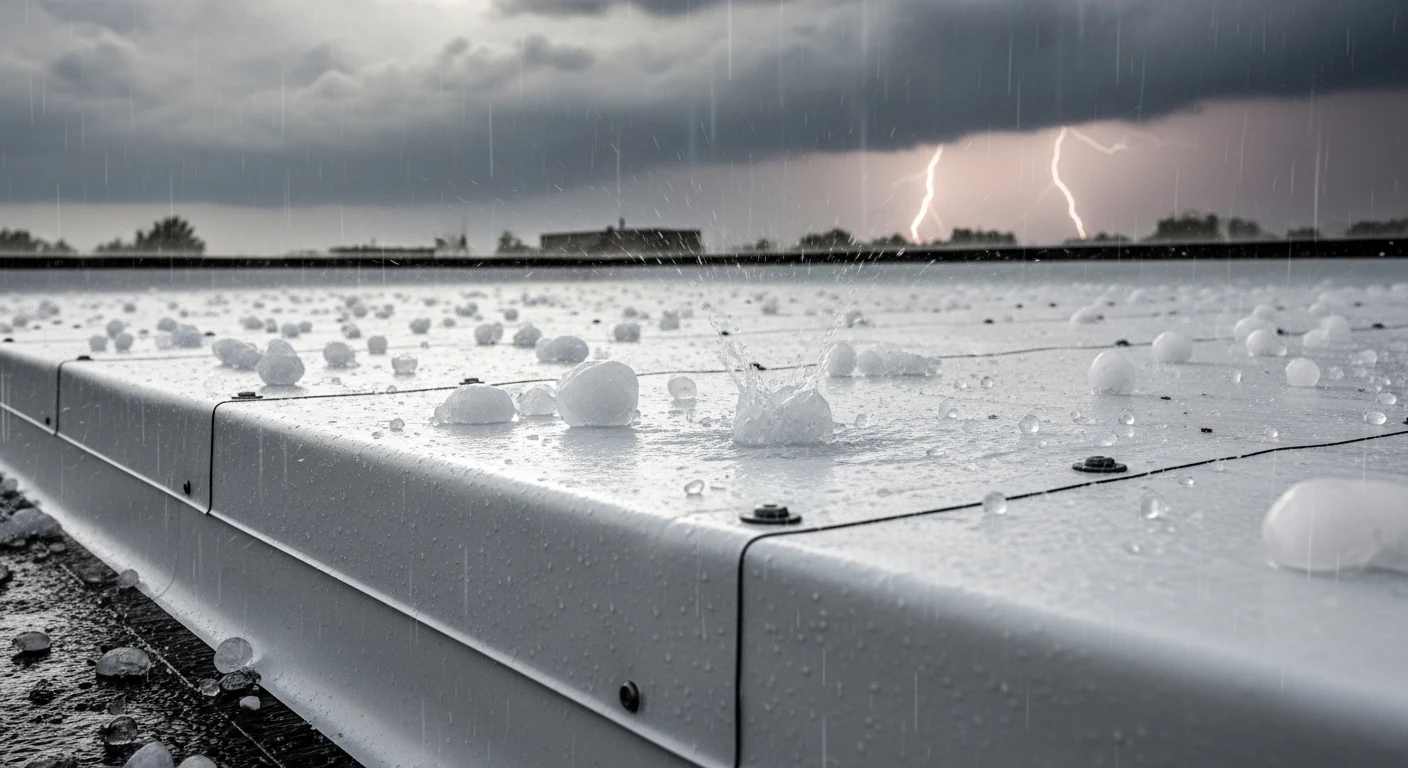
Hail damage is one of the most common causes of commercial roof failure in the United States. Every year, contractors are called in to replace roofs that failed not because they were old — but because the membrane couldn't handle a severe hail event.
The video below shows what happens when you put 60 mil PVC to the test.
The Test: Steel Skin 60 Mil PVC vs 2-Inch Spiked Hail Ball at 100 MPH
A 2-inch spiked hail ball launched at 100 MPH is an extreme impact test — far beyond what most commercial roofs will ever face in the field. Standard hail is smooth and round. A spiked ball concentrates force on a single point, maximizing puncture potential. At 100 MPH, that's a level of impact that would destroy most roofing membranes on the market.
Zero penetration. The Steel Skin membrane absorbed the impact and held. That's what 60 mil PVC built by Steel Skin is designed to do.
Why This Matters for Commercial Roofing Contractors
If you're specifying roofs in hail-prone markets — Texas, Oklahoma, Colorado, the Midwest, the Carolinas — membrane selection is a liability question, not just a performance question. A roof that fails in a hail event means callbacks, warranty claims, and a damaged reputation.
The thickness difference between a 45 mil and 60 mil membrane isn't just a spec sheet number — it's the difference between a membrane that survives severe weather and one that doesn't. At 60 mil, Steel Skin PVC delivers:
- Superior puncture resistance — 60 mil thickness provides significantly more resistance to hail, foot traffic, and debris impact than thinner membranes
- Stronger heat-welded seams — seams are welded to the full thickness of the membrane, creating bonds stronger than the membrane itself
- Dimensional stability — PVC maintains its shape and integrity under thermal cycling and impact stress, unlike membranes that become brittle in cold weather
- Class A fire rating — PVC's natural chlorine content provides fire resistance without additional treatments
PVC vs TPO in Hail Events
TPO is the default membrane for most commercial roofing — but it wasn't engineered with the same impact resistance as PVC. TPO membranes are more prone to cracking in cold temperatures, which makes them particularly vulnerable to hail events in winter and early spring when hail storms are most common in many regions.
PVC membranes remain flexible in cold temperatures, which means they absorb impact rather than crack under it. For contractors in hail-prone markets, that flexibility at low temperatures is a critical performance advantage.
What Contractors Should Specify on Hail-Prone Jobs
- Minimum 60 mil membrane — never go thinner on a hail-prone building
- PVC over TPO — better cold-temperature flexibility and puncture resistance
- FM or UL rated system — specify a system with documented hail resistance ratings for the building's risk profile
- Proper insulation substrate — membrane performance depends on adequate support underneath
Steel Skin 60 Mil PVC — Manufacturer Direct
Steel Skin manufactures 60 mil PVC roofing membrane and ships to contractors and distribution partners nationwide. Factory-direct project pricing, no locked territories and no certification walls.
If you're bidding a job in a hail-prone market, this is the membrane you want on that roof.
Request a sample or get a quote →