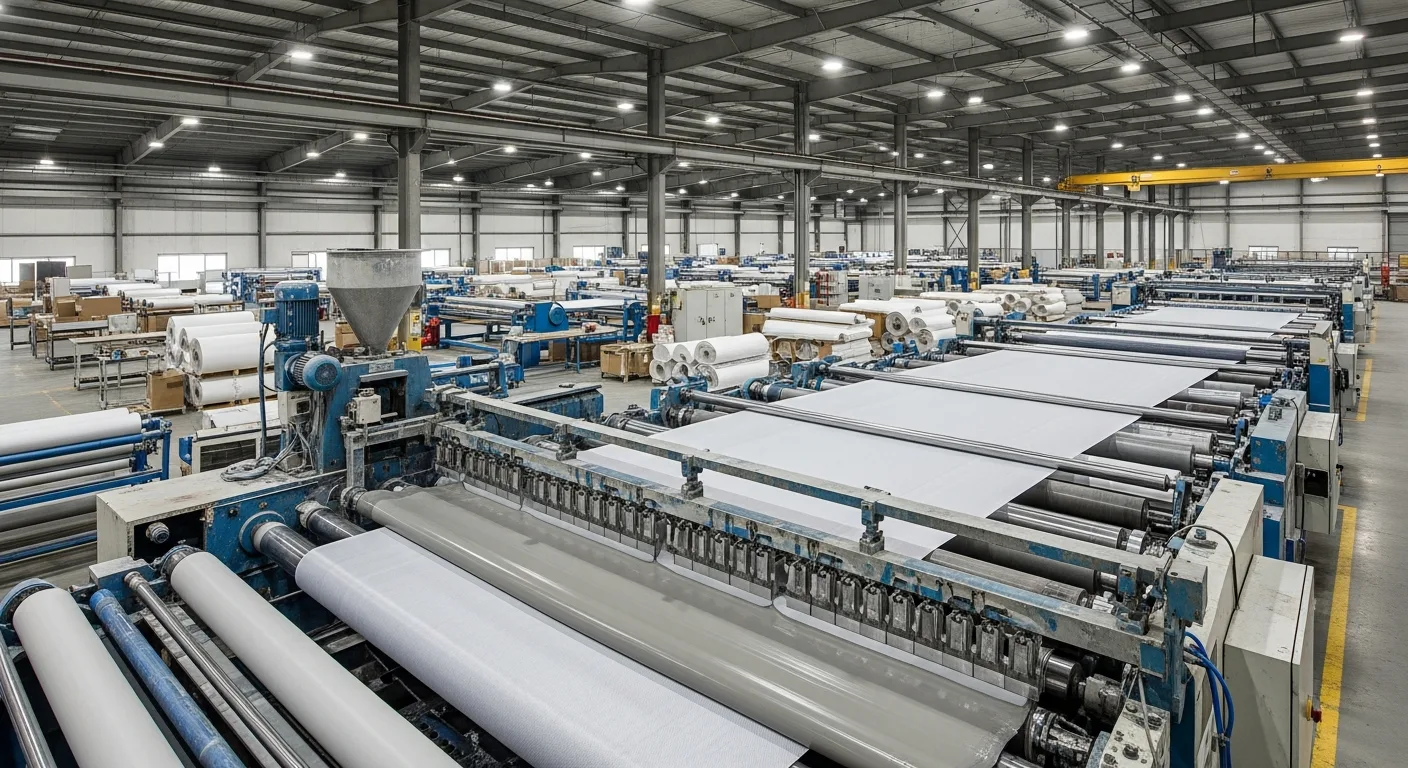
When contractors ask why Steel Skin 60 mil PVC outperforms other membranes on the market, the answer starts at the factory — not on the roof. The difference is knife coating.
Most PVC roofing membranes on the market are produced through calendering — a process where PVC compound is pressed between heated rollers to form a sheet. Knife coating is fundamentally different. In the knife coating process, liquid PVC compound is applied directly onto the reinforcing fabric under precise pressure using a doctor blade, then cured. The PVC is forced into and through the fabric, creating a true molecular bond between the membrane and its scrim.
Why Manufacturing Method Matters on the Roof
The practical difference shows up in three areas that directly affect your installation and warranty exposure:
- Seam strength: Heat welding works by re-fusing the PVC at the seam. With knife-coated membranes, PVC is infused through the full cross-section of the material — the weld engages the entire membrane thickness. Calendered membranes have PVC primarily on the surface layers, meaning seam welds engage less material. The result is measurably weaker seams.
- Dimensional stability: Knife coating bonds the PVC compound to the reinforcing scrim under tension, creating a more stable matrix. Calendered membranes are more prone to shrinkage over thermal cycles — the leading cause of flashing pullback and seam failure over time.
- Puncture and impact resistance: A knife-coated membrane distributes impact energy through a fully bonded composite structure. Calendered membranes, where the PVC layers are less integrated with the scrim, absorb and distribute impact less effectively.
The Intertek Testing Proof
Steel Skin 60 mil PVC is independently tested and certified by Intertek to ASTM D4434 (Report S0599.02-106-31 R0). Every number below is third-party verified — not a manufacturer claim, not a marketing spec sheet. Independent laboratory results.
- Breaking Strength: 1,100 lbf — ASTM Type IV minimum is 275 lbf. Steel Skin hits 4× that. Standard 60 mil TPO tests at ~275 lbf — the bare minimum.
- Seam Strength: 92% of full breaking strength — the heat weld is nearly as strong as the membrane itself. This is what knife coating delivers — PVC infused to the core means the weld engages the full material, not just the surface.
- Puncture Resistance: 50J — 2.5× the ASTM minimum. Backed up by real world testing — watch our membrane take a 2-inch spiked hail ball at 100 MPH with zero penetration. Watch the test →
- Dimensional Stability: 0.03% change — essentially zero movement under thermal cycling. Membranes that shrink pull away from flashings and seams — that's how roofs fail prematurely. At 0.03%, Steel Skin stays exactly where you put it.
- Cold Flexibility: −40°C — zero fracture. TPO stiffens and becomes brittle with age. Steel Skin PVC stays flexible in the most extreme cold weather conditions.
- Heat Aging: No change in material properties — the membrane does not degrade under heat exposure. Post-heat strength tests at 103% — Steel Skin PVC actually gets stronger with age, not weaker.
- Water Absorption: 0.07% — 43× better than the ASTM requirement. Near zero moisture infiltration into the membrane itself.
These numbers don't just meet the ASTM standard — they redefine what a commercial PVC membrane can be. That's what knife coating manufacturing delivers that calendering cannot.
Review the full Intertek certified ASTM test reports at steelskinroofing.com/astm-reports.
What This Means for Your Business
When you install a knife-coated 60 mil PVC membrane, you're putting a product on the roof that is independently verified to perform at 4× the minimum ASTM requirement. That's a story you can tell a building owner. It's a spec you can put in a bid. It's a warranty conversation that's easier to have.
Steel Skin sells direct to commercial roofing contractors — factory-direct pricing, no locked territories, no authorized dealer network. Better material. Intertek-certified performance. Available to contractors and distribution partners nationwide.