Materials & Specs

PVC vs EPDM Roofing Membrane: A Commercial Contractor's Honest Comparison

EPDM has been a commercial roofing staple for decades. But when you stack it up against 60 mil PVC on seam strength, chemical resistance, energy efficiency, and long-term value — the comparison isn't close. Here's the honest breakdown.

By Steel Skin Roofing · 2026-03-13 · 6 min read

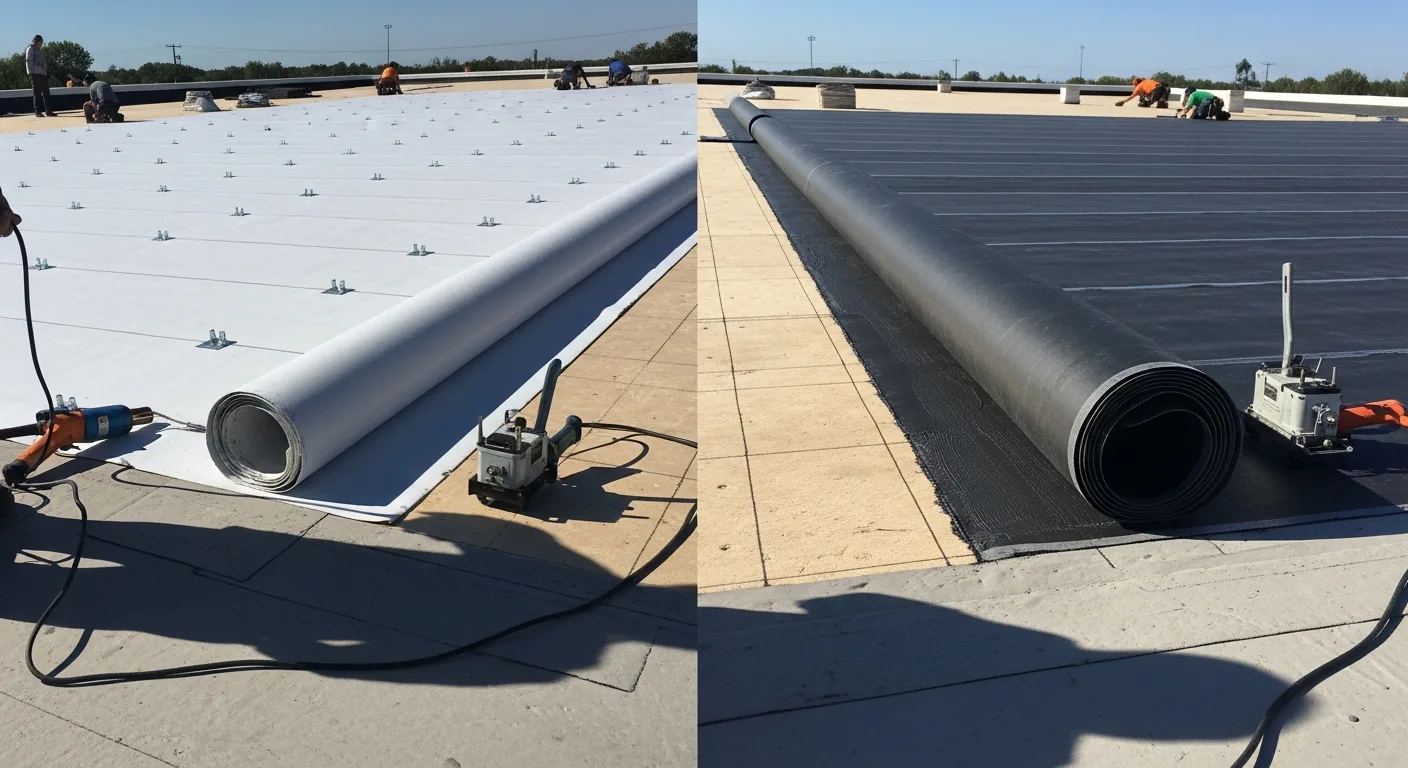
PVC vs EPDM commercial roofing membrane comparison on flat roof
Steel Skin PVC membrane. Compare materials within the complete roof assembly.

EPDM has been around since the 1960s. For decades it was the default for commercial flat roofing — cheap, available, and good enough. But "good enough" is a low bar, and in commercial roofing, good enough often means callbacks, early replacements, and unhappy building owners.

60 mil PVC is a fundamentally different product. Here's an honest side-by-side comparison so you can make the right call on your next commercial bid.

The Core Difference: How the Seams Are Made

This is where PVC and EPDM diverge most significantly — and it's the most important factor in long-term roof performance.

EPDM seams are glued. Adhesive-bonded seams are the weakest point in any EPDM roof. Over time — through thermal cycling, UV exposure, and moisture — adhesive seams lose their bond. Seam failure is the number one cause of EPDM roof leaks. When you're called back to a 7-year-old EPDM roof with a leak, there's a good chance it's a seam.

PVC seams are heat welded. A properly welded PVC seam is stronger than the membrane itself. There's no adhesive to fail, no bond to degrade over time. The two pieces of membrane are literally fused together at the molecular level. Heat-welded seams are why PVC roofs consistently outlast EPDM roofs in independent testing and real-world performance data.

Chemical and Grease Resistance

EPDM is not compatible with oils, grease, or petroleum-based products. Exposure to these substances causes EPDM to swell, soften, and degrade. For restaurants, food processing facilities, industrial buildings, or any commercial property where grease or chemical exposure is a possibility — EPDM is the wrong membrane.

PVC is highly resistant to oils, grease, chemicals, and petroleum products. It's the reason PVC has been the standard for restaurant roofing for decades. If there's any chance of chemical exposure on the roof — specify PVC.

Energy Efficiency

Standard EPDM is black. Black roofing absorbs heat — significantly increasing cooling loads for the building, particularly in warmer climates and summer months. White EPDM is available but at a cost premium, and it still doesn't match the reflectivity of white PVC.

Steel Skin 60 mil PVC is white, reflecting up to 80% of UV rays. For building owners focused on energy costs — and most commercial building owners are — a white PVC membrane delivers measurable cooling cost reductions compared to black EPDM. That's a selling point that wins bids.

Puncture Resistance

EPDM is more vulnerable to puncture damage from foot traffic, debris, and hail than 60 mil PVC. At 60 mil thickness, Steel Skin PVC delivers significantly better resistance to the everyday abuse a commercial roof takes — HVAC technicians walking the roof, debris impact, hail events.

We put our 60 mil PVC through a hail test — 2-inch spiked ball at 100 MPH. Zero penetration. Try that with EPDM.

Watch the hail test here →

Repairability

EPDM repairs are notoriously difficult to do properly in the field. Adhesive patches require precise surface preparation, the right conditions, and the right adhesive — and even then, a patched EPDM roof is never as reliable as the original membrane. Many EPDM repairs fail within a few years.

PVC repairs are straightforward — heat weld a patch in place. The repair is as strong as the original membrane. Contractors who've worked with both consistently report that PVC is faster and more reliable to repair in the field.

Cold Temperature Performance

EPDM becomes increasingly brittle in cold temperatures, making it more vulnerable to cracking and impact damage in winter. In northern climates with harsh winters and frequent freeze-thaw cycles, that brittleness creates real performance risk.

PVC stays flexible in cold temperatures — absorbing impact rather than cracking, maintaining seam integrity through thermal cycling, and performing reliably even in harsh winter conditions.

Cost Comparison

EPDM has traditionally priced lower than PVC — that's been its main selling point. Steel Skin's manufacturer-direct supply model helps contractors compare the systems on a project-specific basis.

Steel Skin 60 mil PVC is quoted manufacturer direct, while delivering measurably better performance across every category that matters for commercial roofing longevity.

When you factor in longer lifespan, fewer callbacks, easier repairs, and better energy performance, 60 mil PVC can deliver the better lifecycle value.

The Bottom Line

EPDM made sense when it was significantly cheaper than the alternatives. At Steel Skin's manufacturer-direct pricing, that price advantage is gone — and with it, the main reason to spec EPDM on a commercial job.

60 mil PVC wins on seam strength, chemical resistance, energy efficiency, puncture resistance, repairability, and cold temperature performance. For commercial roofing contractors who care about doing the job right and minimizing callbacks, the choice is clear.

Ready to make the switch to 60 mil PVC?
Request a sample from Steel Skin — manufacturer-direct pricing →

Frequently asked questions

Is PVC roofing better than EPDM?

Yes, for most commercial applications. PVC outperforms EPDM on seam strength (heat welded vs glued), chemical and grease resistance, energy efficiency (white vs black membrane), puncture resistance, and cold temperature flexibility. Steel Skin provides manufacturer-direct project quotes for an accurate system comparison.

Why do EPDM roofs fail?

The most common cause of EPDM roof failure is seam failure. EPDM seams are adhesive-bonded, and over time those adhesive bonds degrade through thermal cycling, UV exposure, and moisture. When the seam bond fails, water infiltrates. PVC seams are heat welded — fused at the molecular level — and are stronger than the membrane itself, eliminating the seam failure risk.

Can EPDM be used on restaurant roofs?

No — EPDM is not compatible with oils, grease, or petroleum products. Exposure causes EPDM to swell and degrade. For restaurant roofing or any commercial building where grease exhaust or chemical exposure is possible, PVC is the correct specification. PVC's chemical resistance makes it the industry standard for restaurant and food service roofing.

How does EPDM perform in cold climates?

Poorly compared to PVC. EPDM becomes brittle in cold temperatures, increasing the risk of cracking and impact damage in winter. PVC stays flexible at low temperatures, maintaining performance through freeze-thaw cycles and cold weather hail events. For contractors in northern climates, PVC is the better cold-weather specification.

What does 60 mil PVC roofing membrane cost compared to EPDM?

Steel Skin 60 mil PVC is quoted manufacturer direct. When you factor in longer lifespan and fewer callbacks, PVC can deliver better lifecycle value even if upfront material costs differ.

Additional planning resources · 2026-09-30

PVC vs EPDM: compare the products behind the proposal

Choosing between PVC and EPDM rubber roofing starts with the building and the specified system. Ask each bidder to identify the membrane, thickness, attachment, insulation, flashing and warranty. A material name alone does not establish which proposal will perform better or cost less over time.

DecisionWhat to compare
Seams and repairsPVC commonly uses hot-air-welded seams. EPDM systems can use manufacturer-specified splice tapes, including factory-applied tape. Ask for the applicable installation and repair details; neither approach eliminates workmanship risk.
Climate and exposureReview the selected product's temperature limits and chemical compatibility. Do not assume that EPDM becomes brittle simply because the weather is cold, or that any PVC formulation handles every chemical exposure.
Energy performanceCompare documented roof-surface properties, insulation and the building's climate. Membrane color alone does not establish a guaranteed utility saving.
Price and warrantySeparate membrane cost from preparation, insulation, accessories, labor and freight. Compare warranty issuer, coverage, exclusions and maintenance duties alongside price.

Use manufacturer documentation for the specific system

Carlisle's EPDM resources describe flexible EPDM membranes and factory-applied splice tape. Johns Manville's PVC with KEE documentation describes a heat-weldable PVC product and its chemical-resistance characteristics. Those are manufacturer-specific examples, not performance evidence for Steel Skin products.

Request an equivalent-scope PVC quote

  • Provide the project ZIP, measured roof area or takeoff, and needed-by date.
  • Identify the specified membrane thickness and roll quantities, plus insulation, cover board and accessories.
  • State whether you need material supply, freight or coordinated warehouse pickup; obtain installation pricing separately from your contractor.
  • Request the product-specific documentation and written warranty terms before accepting the proposal.

Review Steel Skin's 60 mil PVC guide, compare PVC roofing cost scope, and check the available PVC test report and sample limitations. Then request a project-specific PVC material quote.

Project planning questions

Is EPDM the same as rubber roofing?

EPDM is a synthetic rubber commonly used in single-ply roofing. Confirm the exact membrane and system when a proposal says rubber roofing; the label alone does not identify its thickness, seam system or warranty.

Is PVC roofing always better than EPDM?

No. Compare the exact products, roof assembly, building exposure, installation requirements and written warranty. PVC and EPDM describe material families, not a universal ranking for every project.

Are all EPDM roof seams made with liquid glue?

No. Modern EPDM systems can use manufacturer-specified splice tapes, including factory-applied tape. Follow the selected system's preparation, primer and seaming instructions.

Does EPDM automatically become brittle in cold weather?

No. Manufacturer documentation describes EPDM flexibility. Distinguish the membrane's service performance from installation temperature limits, and follow the instructions for the specified membrane, adhesives and accessories.

How should I compare PVC and EPDM roofing costs?

Request equivalent scope: membrane, roof preparation, insulation, cover board, accessories, labor, disposal and freight. Steel Skin provides project-specific material quotes; do not assume a material price includes installation or proves lower lifetime cost.

Plan your next step

Request PVC project pricing

Send your project ZIP, required quantity and needed-by date. We will confirm product options and delivery for your project.

Request a material quote